The world’s fastest supercomputer, Frontier, consumes about 21 megawatts of power. Your brain performs comparable feats using roughly 20 watts, about the same as a dim lightbulb. That difference is not just impressive. It points to a deeper problem with how modern computing works.
The systems driving generative AI require enormous amounts of energy. As demand grows, so do the environmental and practical costs. That has led scientists to ask a question that would have sounded like science fiction not long ago. What if the most efficient computer is not something we build from silicon, but something we grow.
That question is at the center of a new field known as Organoid Intelligence, or OI. Instead of trying to copy the brain using code, researchers are experimenting with living human brain cells as a form of biological computing. Below are five key insights that explain why this research matters.
1. Biological Brains Are Far More Efficient Than Supercomputers
This is where the comparison between humans and machines becomes hard to ignore. Biological learning has two clear advantages over machine learning: energy efficiency and data efficiency. The human brain operates at roughly a million times the efficiency of modern computers when performing similar tasks.
To put that into perspective, your brain can solve complex problems using a fraction of the energy required by silicon-based systems. That efficiency also shows up in how learning works. Humans can understand a simple same versus different task with as few as ten examples. As recently as 2018, advanced machines struggled with the same task even after being trained on millions of samples.
AlphaGo is a useful reference point. The system was trained using data from around 160,000 games of Go. For a human to gain that level of experience would take more than 175 years of play. The energy cost of training AlphaGo was enormous.
AlphaGo was trained for four weeks using fifty GPUs, consuming roughly four times ten to the tenth joules of energy. That is about the same amount of energy required to sustain an active adult human for an entire decade.
That contrast raises an uncomfortable question. If the brain is already this efficient, are we building intelligence in the wrong way?
2. Brain Powered Computers Already Exist
This technology is not theoretical. You can already rent time on a computer powered by living brain tissue.
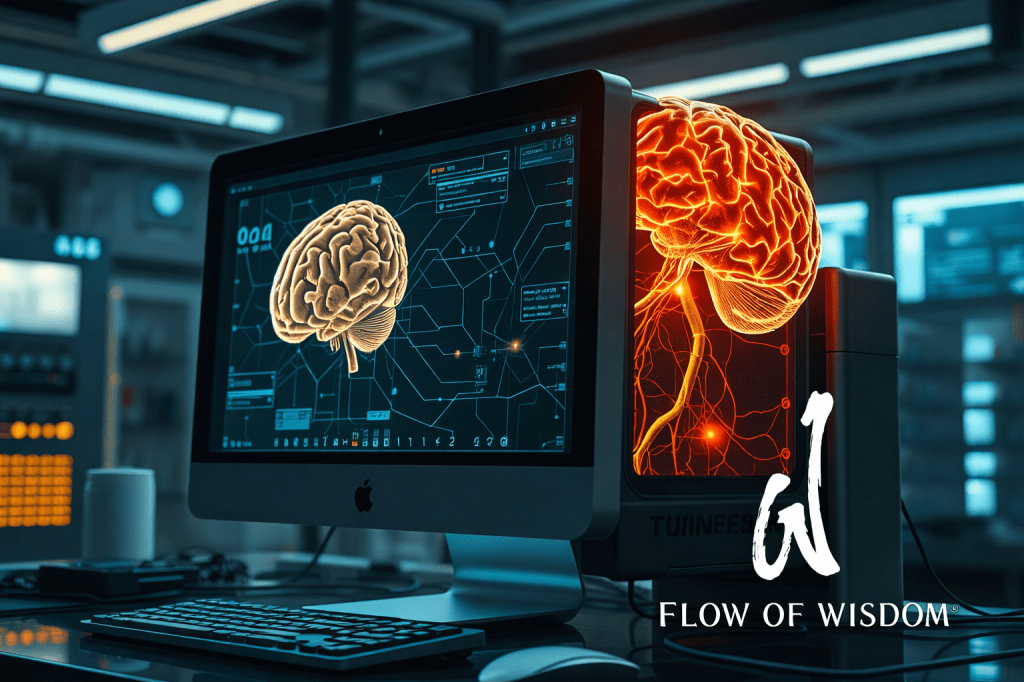
A Swiss company called FinalSpark has launched the Neuroplatform, the first publicly available computing system based on human brain organoids. For a monthly fee, researchers can run experiments on living neural tissue connected to conventional computers.
Each processing unit contains four tiny brain organoids, each about half a millimeter wide. These clusters of neurons are connected to electrodes that send and receive electrical signals. To guide learning, researchers stimulate the organoids and selectively expose them to dopamine, mimicking how reward systems work in the human brain.
The technology is still early. These organoids currently survive for around one hundred days. But the fact that this platform exists at all signals a real shift. We are no longer just talking about biological computing. We are interacting with it.
3. Organoid Intelligence Is a Shift From Software to Wetware
Organoid Intelligence represents a different way of thinking about computation. Artificial intelligence tries to recreate intelligence using silicon and algorithms. OI starts with the biological hardware itself and then asks what it can learn.
This approach relies on three dimensional brain organoids rather than flat cell cultures. That distinction matters. These organoids more closely resemble how real brains are structured and how they function.
They contain a much higher density of cells, allowing more complex interactions. They show spontaneous electrical activity, confirming that neurons are forming active connections. Their axons are coated with myelin, which dramatically increases signal speed. They can also include support cells like astrocytes and oligodendrocytes, which play a critical role in learning and memory.
In other words, this is not just living tissue. It is organized, active, and adaptive tissue.
4. Computing With Life Goes Beyond Human Brains
While brain organoids get the most attention, they are not the only form of biological computing being explored. Researchers are also studying fungi and bacteria as potential computing systems.
Fungal networks, known as mycelia, show electrical signaling patterns similar to neurons. These networks may be useful for pattern recognition and other computational tasks. They are also resilient, easy to grow, and environmentally robust.
Cellular computing takes a different approach. It uses modified living cells, such as bacteria, to process information and respond directly to their surroundings. These systems could be deployed in environments where traditional computers fail. For example, a bacterial system placed in a lake could continuously monitor ecological conditions in ways no sensor network could replicate.
As researcher Andrew Adamatzky has noted, fungal computing offers advantages in ethics, cost, resilience, and ease of integration. Not all intelligence needs to look like a brain.
5. Ethical Questions Are Being Built Into the Research
Using human brain cells for computing raises questions that cannot be ignored. As these systems become more capable, researchers are forced to confront difficult issues. Could organoids experience pain. Could they suffer in any meaningful way.
This challenge is often referred to as the Greely Dilemma. The more successful brain modeling becomes, the more ethical concerns it creates. The very goal of understanding the brain brings moral responsibility with it.
To address this, researchers are adopting an embedded ethics approach. Ethicists, scientists, and members of the public work together throughout the research process rather than after breakthroughs occur. The goal is not to stop progress, but to guide it responsibly.
This is not a future problem. It is a present one.
Conclusion: Rethinking Intelligence
This research is not just about faster computers. It is about redefining what computation is and where intelligence comes from. By learning how living systems process information, we may unlock new approaches to medicine, energy, and artificial intelligence itself.
But power always brings responsibility. If we begin creating systems that resemble living intelligence, even in simple forms, we must be willing to ask hard questions about care, limits, and accountability.
As we move closer to computing with living cells, what new responsibilities are we prepared to accept as creators of a new kind of intelligence?
Sources: https://www.science.org/doi/10.1126/science.aeb1510 https://www.scientificamerican.com/article/these-living-computers-are-made-from-human-neurons/
https://www.psypost.org/how-scientists-are-growing-computers-from-human-brain-cells-and-why-they-want-to-keep-doing-it/ https://www.frontiersin.org/journals/science/articles/10.3389/fsci.2023.1017235/full

 FLOW OF WISDOM®
Leave your questions and comments